Translating dreams into terminology
When trying to dissect and analyze what AI can do for any industry, and specifically for F&B, a good starting point is to match data science terminology with the abstract notions of solutions forming in the heads of executives and researchers. A few things are clear to everyone — there is an urgent need to understand whether there is actual value in AI tools, and there is a plethora of so-called “AI solutions” out there, some are add-ons to existing solutions, many of which promise a magical fix and come with a hefty price tag. Adopting an AI solution usually requires additional digitization efforts, and can be a heavy lift for an organization. To make informed decisions, one must first become familiar with the limitations of the technology. Since many stakeholders do not have a computer or data science background, we must take the time to put some foundations in place – hence, coming full circle to terminology:
Zero-Shot Prediction
THE dream. Zero-shot prediction describes a model that is able to give accurate enough predictions on classes or tasks it had never seen before during training.
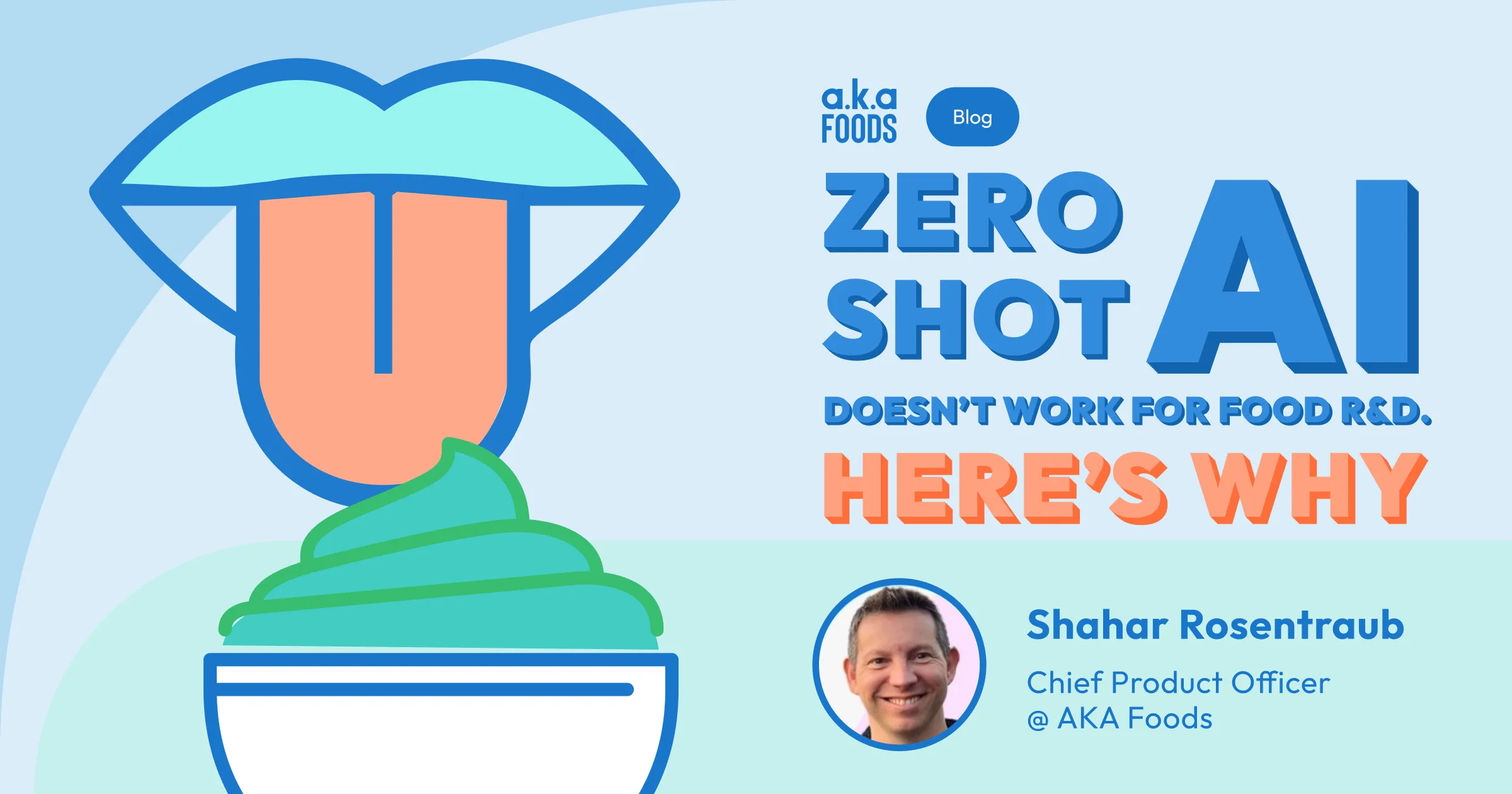
An example in the F&B space – a model that can predict the texture or mouthfeel of a completely new product (for example: a “Green Goo”). The product might have a unique process and formula, and no previous experiments were done to collect information about it.
The appeal is obvious – if such a model exists, assuming we can apply the right constraints, such as cost of materials, process, and regulations, we have built a complete in-silico food lab.
Few-Shot Prediction
A few-shot model takes us away from in-silico and puts us back in the lab with all the dirty dishes. Few-shot predictions require the model to view several labeled samples for each new class or task in order to provide accurate enough predictions. A simple and understandable example from another domain is face recognition – your phone asks for several images to adapt the model to your specific features. The model is not being trained again from the start; rather, it is fine-tuned to your characteristics and optimized to solve a more specific problem. Returning to our “Green Goo”, we will have to actually go to the lab, collect the materials, mix everything together, taste what we made and record the outcomes to “teach” our model. Eventually, we will be able to get some good predictions on this class without all the lab preparations.

Generative AI
The rise of the LLMs (Large Language Models) and now LRMs (Large Reasoning Models) has given many the illusion that we are in the era of zero-shot prediction. The nature of these models is to generate an outcome in an area outside the materials used to train the model. The ease with which tools like ChatGPT can generate a poem on any subject in specific styles, or generate a fictional image that never existed, creates the illusion that such tools can also generate an amazing new industrial recipe from scratch.
The challenges for zero-shot in the food industry
We will try to group the challenges specific to the F&B industry when trying to implement generative AI tools and reach the zero-shot prediction target:
The Nature of Food Processing Complexity
Industrial food engineering operates at the intersection of chemical, mechanical, biological, and sensory domains. Unlike domains with clear rules and boundaries, food systems exhibit emergent properties that arise from countless molecular interactions. These interactions create a system too complex to model from first principles alone. The sheer molecular complexity of food we so simply understand in our heads (for example – tomato soup) makes the in-silico solution a faraway one.
The Sensory Gap
Food quality is ultimately judged by human perception—taste, texture, aroma, and mouthfeel. These subjective experiences cannot be fully captured by chemical composition or physical measurements alone. Zero-shot AI lacks the ability to bridge this fundamental sensory gap without extensive training on human preference data. Even if we would have perfect simulators for the food we create, we are far from having perfect simulators of human organoleptic variability and preference.
Batch Variability and Biological Complexity
Agricultural inputs vary significantly between harvests, regions, and seasons. Even seemingly identical ingredients can behave differently during processing due to subtle biological variations. Zero-shot AI cannot anticipate these variations without extensive experience with specific ingredients and their processing behaviors. Even if we had perfect simulators for our food and sensory outcomes, they would still have to adapt and learn all the time.
Non-Linear Processing Dynamics
Food processing involves phase transitions, enzymatic reactions, and structural transformations that are highly non-linear and often chaotic. Small changes in processing parameters can lead to dramatically different outcomes. These dynamics defy the kind of generalization that zero-shot learning requires. Processes are traditionally also recorded less effectively than formulations and have many hidden tips and tricks that remain in the practitioner’s head.
Multi-Scale Challenges
Food engineering problems exist across multiple scales—from molecular interactions to macro-level structural properties. An AI system would need to simultaneously reason across these scales, connecting molecular behavior to final product characteristics without ever having seen examples of these connections.
Regulatory and Safety Constraints
Food production operates under strict safety regulations that vary by region. Zero-shot AI lacks the domain-specific knowledge of these regulatory frameworks and cannot account for safety margins required in commercial production.
The Human Element
Much of food engineering knowledge remains tacit—held by experienced engineers and operators who develop intuition through years of hands-on work. This knowledge is difficult to formalize in ways that would enable zero-shot learning. Mind mapping experts’ efforts can cause pushback from practitioners concerned about the impact AI may have on their job security.

The Big Knowledge Gap
If we try to summarize all the above factors into a one liner, we might say that in F&B, AI systems have a knowledge gap. LLMs that are trained on “all available human knowledge” are not actually training on knowledge relevant to solving the problem at hand. The biological, physical, mechanical, organoleptic, and regulatory gaps in the available training data are so large that any generative prediction done without grounding in actual data, and adding all the effecting factors into the problem context, will inherently cause hallucinations of the model. The immediate dissatisfaction caused by getting a completely fabricated (albeit eloquent) response to a question vs the expectation for an all-knowing AI causes many professionals to dismiss AI entirely and automatically tag any AI solution as part of the “hype”.
The problem here lies not only in the complexity of the problem, but also in the availability of data. In the F&B industry, this data is stored in many silos inside and across organizations – in the NPD (New Product Development) lab, sensory labs, in the hands of the sales department, ingredient companies, scale-up experts, and more. The F&B industry is very similar to Pharma in that the organizational knowledge is the competitive advantage. How can models improve if the data they are exposed to is limited and they have to re-learn all the hidden relations for each new problem?
Conclusion and the Path Forward
Zero-Shot AI remains a promising yet distant aspiration for industrial food engineering. Realistically, AI’s immediate future lies in hybrid systems, combining human expertise, empirical data, and iterative learning. Approaches such as federated learning and consortium-based collaborations to enhance data sharing and transparency represent viable near-term strategies. Organizations should begin with phased implementations, starting from clearly defined, manageable tasks, expanding gradually based on documented successes and incremental improvements.
Similar to advancements in the medical field, progress in AI for food engineering requires both clarity about our ultimate goals and honesty about current limitations. Just as medical professionals didn’t jump straight to personalized treatment without first developing a foundational understanding of biology, chemistry, and human physiology, the food industry must first develop robust models based on well-understood relationships and gradually expand from there. Rather than expecting an overnight revolution, the path forward lies in systematic, incremental steps—establishing clear metrics, collecting targeted data, and continuously validating model predictions against real-world outcomes.
By adopting this methodical approach, the industry can move beyond the cycle of hype and disappointment to create sustainable value through AI systems that genuinely enhance human expertise rather than attempting to replace it. The true potential of AI in food engineering will be realized not through magical shortcuts, but through patient, deliberate progress toward well-defined objectives.